Book Makers Craft

Learn · Tools & Materials

Understand what you are working with.

The right tool or material is not simply the one another bookbinder uses. It is the one suited to the structure, process, desired result, and stage of your learning. BMC guides explain what common tools and materials do, why they are used, and how to begin without purchasing more than you need.

Every guide answers

  • What is it?
  • What does it do?
  • Why is it used?
  • Do I need it to begin?
  • What alternatives exist?
  • When might I upgrade or choose a specialized version?
  • What related tools, materials, skills, or lessons should I explore next?

Know Your Tools

01

Bone Folder

Start Here

A collection of bone and Teflon folders arranged on a wooden bench.
Bone Folder

A smooth hand tool used to create crisp folds, crease paper, shape materials, smooth adhered surfaces, and work cloth or paper into joints. It is one of the first specialized tools many bookbinders choose to own.

Beginner guidance

A clean, smooth substitute may work for limited tasks, but avoid sharp edges or materials that can mark or polish paper unexpectedly.

Related terms: Signature · Turn-in · Hinge

02

Awl

Start Here

Piercing and cutting tools laid out on a grey cutting mat.
Awl

A pointed tool used to pierce sewing stations in signatures and create controlled holes in paper, board, or other materials.

Beginner guidance

A suitable sharp piercing tool may work for an early project, but control, hole size, handle comfort, and safe use matter.

Related terms: Sewing station · Signature

03

Bookbinding Needle

Start Here

A drawer of colorful linen thread spools with scissors and sewing tools.
Bookbinding Needle

A needle selected for sewing book structures. Needle length, eye size, point, and thickness should suit the thread, paper, and sewing method.

Beginner guidance

Some sturdy sewing needles may work. The needle should pass through prepared stations without unnecessarily enlarging or damaging them.

Related terms: Sewing station · Swell

04

Metal Ruler

Start Here · You May Already Own This

Measuring and cutting tools on a cutting mat.
Metal Ruler

A straight measuring and cutting guide. A metal edge is more resistant to damage from a knife than plastic or wood.

Beginner guidance

Use a ruler with clear markings and a stable edge. A cork-backed or nonslip ruler may improve control.

Related terms: Grain direction · Square

05

Craft Knife

Start Here · You May Already Own This

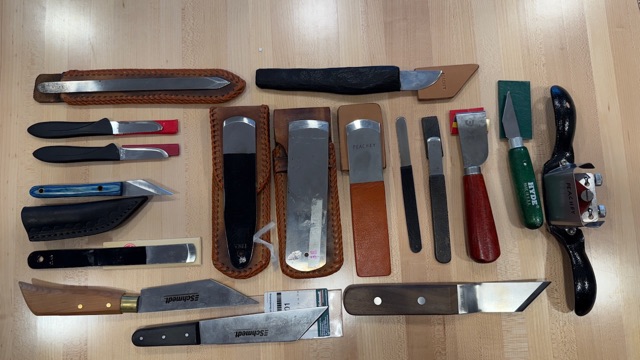
Bookbinding and paring knives arranged in a flat lay on a wooden bench.
Craft Knife

A sharp cutting tool used for paper, cloth, board, and detail work. Blade choice and cutting technique should match the material.

Beginner guidance

Sharp blades, controlled light passes, a safe cutting direction, and an appropriate cutting surface are more important than purchasing an elaborate knife.

Related terms: Board · Grain direction

06

Cutting Mat

Start Here · You May Already Own This

A self-healing cutting mat beneath cutting tools.
Cutting Mat

A protective cutting surface that helps preserve blades, protect the workbench, and support accurate cutting.

Beginner guidance

Use a flat, stable surface designed to tolerate cutting. Avoid surfaces that encourage slipping or damage the blade.

07

Brush

Start Here · You May Already Own This

Paste and glue brushes of many sizes beside cutting tools on a bench.
Brush

Used to apply paste, PVA, adhesive mixtures, color, or other materials. Brush size, stiffness, and fiber type should suit the task.

Beginner guidance

A clean general-purpose brush may work, but dedicate brushes to compatible materials and clean them promptly.

Related terms: Adhesive

08

Square

Helpful Upgrade · You May Already Own This

An organized pegboard workshop wall of bookbinding tools and supplies.
Square

A measuring and layout tool used to establish and verify right angles when cutting board, paper, cloth, and other components.

Beginner guidance

A reliable woodworking or drafting square may work well. Accuracy matters more than whether the tool is marketed specifically for bookbinding.

Related terms: Board · Square

09

Weights

Start Here · You May Already Own This

A restored antique cast-iron book press with brass details.
Weights

Used to keep materials flat, maintain contact during drying, hold work in position, and provide simple pressing pressure.

Beginner guidance

Heavy books, clean boards with weight on top, or other stable solutions may serve as a beginner press. Protect the work from dirt, texture, moisture, and uneven pressure.

Related terms: Pressing · Adhesive

Understand the Materials

01

Paper and Paper Grain

A flat file drawer of decorative and Japanese papers in many colors.
Paper and Paper Grain

Paper is a structural material, not only a surface for writing or decoration. Fiber direction affects folding, opening, warping, strength, and the behavior of the finished book.

Guide focus

Teach learners how to identify grain direction and plan cuts so grain generally runs parallel to the spine in common book structures.

Related terms: Grain direction · Signature · Folio

02

Book Board

Book boards being prepared on a workbench during a restoration.
Book Board

A dense board used to create covers, cases, and structural components. Thickness, density, stiffness, cutting quality, and grain direction affect the finished result.

Guide focus

Explain common board types and practical selection based on book size, structure, and intended use.

Related terms: Board · Square · Grain direction

03

Book Cloth

A mustard-yellow cloth-covered flatback notebook lying on a cutting mat.
Book Cloth

A covering material designed or prepared for book use. The backing and surface help it accept adhesive while limiting strike-through and supporting durable handling.

Guide focus

Compare prepared book cloth with ordinary fabric and explain why some fabrics require backing or preparation.

Related terms: Book cloth · Turn-in · Cover

04

Decorative Paper

A hand lifting a sheet of hand-marbled paper from a stack.
Decorative Paper

Paper used for covers, endpapers, doublures, linings, labels, and decorative elements. Weight, grain, surface, moisture response, and print method affect suitability.

Guide focus

Encourage testing for grain, colorfastness, adhesive response, cockling, and compatibility with adjacent materials.

Related terms: Endpaper · Grain direction · Cover

05

Thread

Spools of linen sewing thread in many colors organized in a drawer.
Thread

Thread joins sections and may contribute to structure, flexibility, durability, and appearance. Fiber, thickness, twist, strength, and waxing influence sewing behavior.

Guide focus

Explain why linen thread is common while acknowledging other threads used for particular structures and decorative effects.

Related terms: Signature · Swell · Sewing station

06

Needles

Thread and needles organized in a workshop drawer.
Needles

Needles should be selected in relation to thread, paper, prepared sewing stations, and sewing structure. Eye size, thickness, length, and point affect handling.

Guide focus

Connect this guide to the bookbinding needle tool guide and explain how an oversized needle may unnecessarily enlarge sewing holes.

Related terms: Sewing station

07

PVA

PVA, methyl cellulose, and paste supplies arranged on a bench.
PVA

Polyvinyl acetate adhesive is widely used in bookbinding because it is strong, flexible, and convenient. Formulations vary, and working time, moisture, reversibility, and long-term behavior should be considered.

Guide focus

Avoid treating every white glue as equivalent. Explain product suitability, application amount, drying, cleanup, and when another adhesive or mixture may be preferred.

Related terms: Adhesive · Pressing

08

Paste

Starch paste ingredients and adhesive supplies on a workbench.
Paste

A water-based adhesive category that may include wheat, flour, rice, and other starch-based pastes. Paste generally offers useful working time and repositionability, and its properties vary with ingredients and preparation.

Guide focus

Future guides may compare paste types and include tested recipes. Explain moisture management, preparation, storage, spoilage, application, and project suitability.

Related terms: Adhesive · Grain direction

09

Mull / Super

A roll of woven sewing tape beside board on a cutting mat.
Mull / Super

An open-weave material applied across the spine of a text block to support attachment and reinforce the connection between the text block and cover in many structures.

Guide focus

Explain terminology variations, fiber and weave differences, placement, adhesive use, and how the material functions with other spine linings.

Related terms: Mull · Case binding · Hinge

Next step

Terms in these guides link into the glossary, and the learning roadmap shows where foundational skills come next.